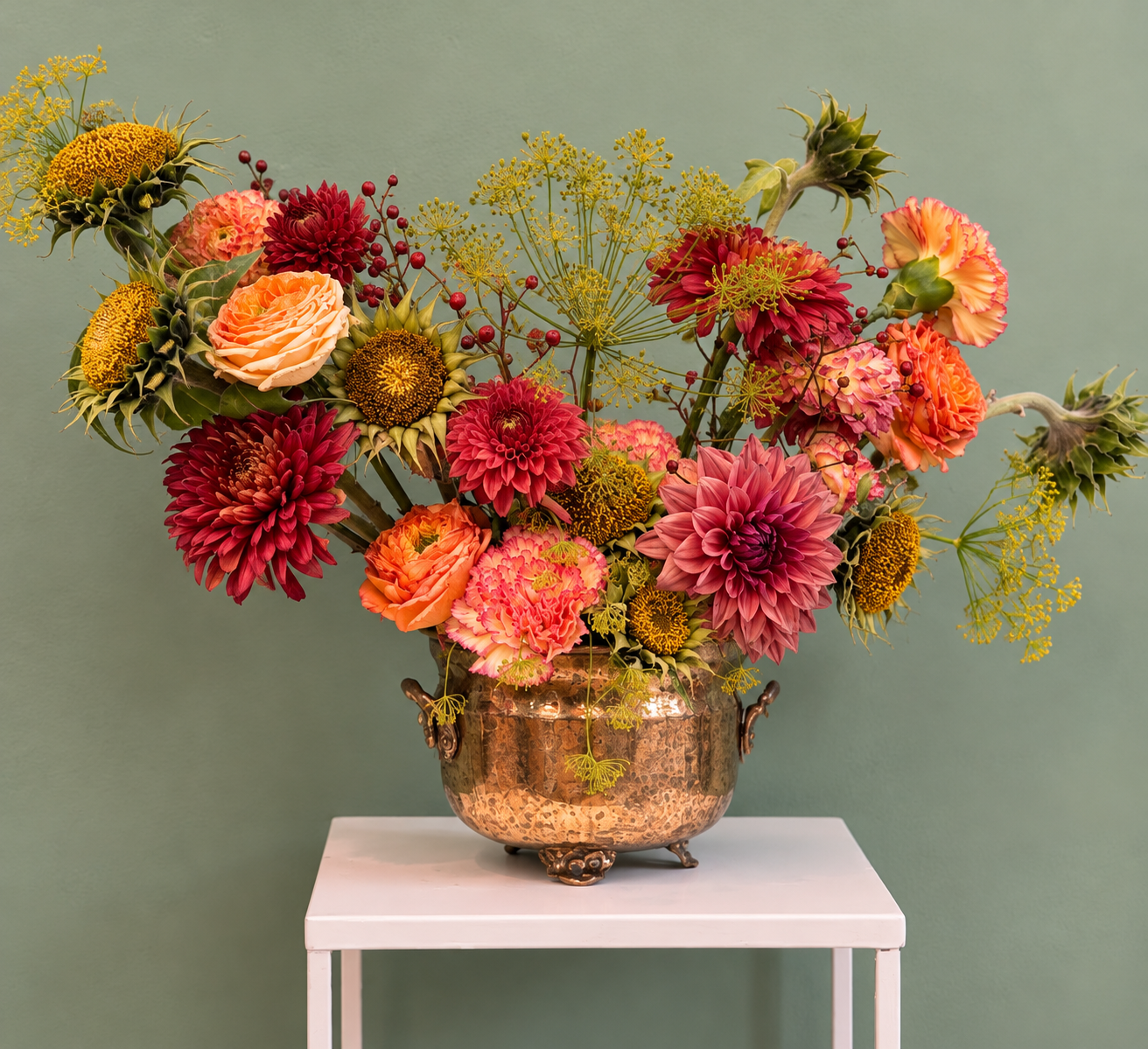
Sunflowers Reimagined: Beauty Beyond the Yellow Petals
Can a sunflower still be a sunflower when its most recognisable feature is gone?
Sunflowers are among the most familiar flowers in the world. Their bright yellow petals and bold, dark centres have become synonymous with summer, warmth and abundance. But what happens when we remove the expected and look at the flower differently?
In this arrangement, sunflowers take on an entirely new character. Without their traditional yellow petals, their sculptural centres become the focus. Their intricate textures, earthy tones and architectural shapes bring depth and an almost sculptural quality to the composition.
Combined with dahlias, roses, richly coloured chrysanthemums and delicate seasonal foliage, they become part of a sophisticated autumn palette of rust, coral, burgundy and muted gold.
Breaking away from the familiar
Floral design is not only about selecting beautiful flowers. It is also about discovering unexpected qualities in familiar materials.
Removing the petals from a sunflower transforms its visual identity. What was once a cheerful, instantly recognisable bloom becomes a textural element that introduces contrast, rhythm and a more contemporary aesthetic.
The flower has not lost its character. Instead, we are invited to see a different side of it.
This approach challenges our expectations of what flowers should look like and encourages us to experiment with shape, colour, texture and proportion.
Is it acceptable to alter a flower to achieve a design effect?
This raises an interesting question for floral designers: How far should we go in manipulating nature to realise a creative vision?
In my view, floral design has always involved artistic intervention. We cut stems, remove leaves, separate flowers, reshape materials, and combine them in ways that do ’t necessarily occur in nature.
Removing petals can be another legitimate design decision, provided it is done thoughtfully. Consider the flower's condition, how much material you discard, and whether the intervention genuinely enhances the design.
Sustainable floristry asks us to look beyond the final aesthetic and consider how we use our materials. For example, could we work with naturally mature flower heads rather than sacrificing fresh blooms purely for their appearance?
There is no single answer. The key is to understand the material, make conscious decisions, and recognise that creative freedom also comes with responsibility.
Seeing flowers differently
For me, this is one of the most exciting aspects of floral design: learning to look beyond the obvious and discovering possibilities where others might see only the familiar.
A sunflower does not always need its yellow petals to make a statement. Sometimes, what remains is even more interesting.
What do you think? Is removing a flower's petals a creative reinterpretation of nature, or does it go too far?
I'd love to hear your thoughts. Love Julia