The Art of Seasonal Floristry: Designing with What the Season Gives Us
Great floral design begins long before the first stem is placed in a vase. It begins with understanding the season.
In contemporary floristry, it is tempting to work with the same familiar flowers and colour palettes throughout the year. Yet every season offers its own extraordinary materials, textures and possibilities. Learning to recognise and work with these changes is one of the most valuable skills a floral designer can develop.
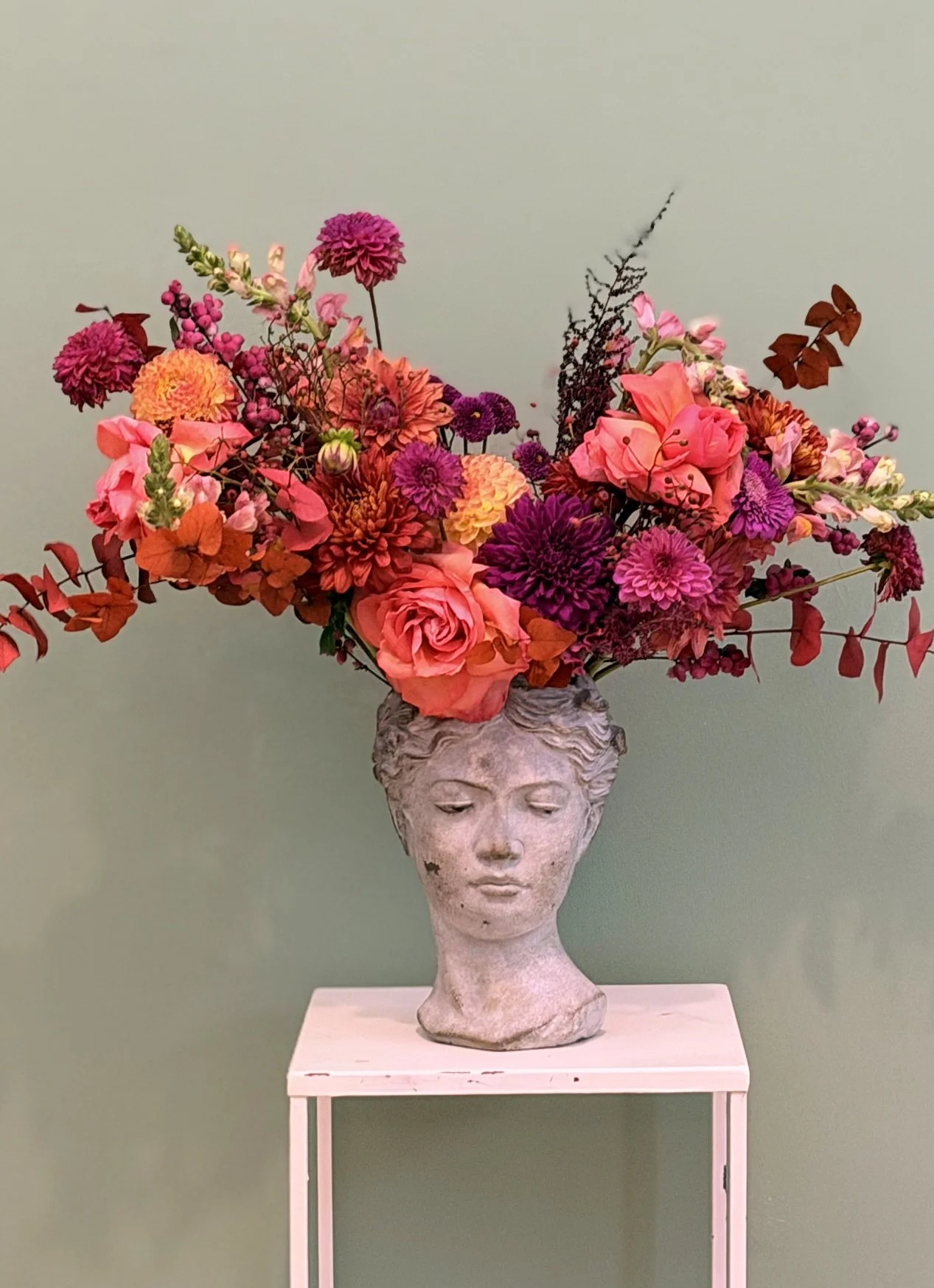
Autumn, in particular, offers far more than the traditional combination of rust, brown and orange. Chrysanthemums, dahlias, hydrangeas, amaranthus, berries and textural foliage provide an incredible range of forms and colours, from muted and atmospheric to bold and unexpected.
Start with the flowers, not the colour palette
Rather than beginning with a predetermined design, try visiting your flower market with an open mind. Observe what is available, which varieties catch your attention and how different flowers interact with one another.
A single variety can inspire an entire design. The shape of a chrysanthemum, the delicate movement of a branch or the subtle transition between two shades can become the starting point for a composition.
Working seasonally encourages us to respond to the material instead of forcing the flowers into a preconceived idea.
Explore unexpected colour combinations
Seasonal design does not have to follow predictable colour conventions. Fuchsia and lime, deep burgundy with soft lilac, or warm apricot combined with cool blue-grey can all create striking autumn arrangements.
The key is understanding the relationship between colours, their proportions and the visual weight of individual flowers. A bright accent can transform an otherwise restrained palette, while contrasting textures add depth and movement.
This is where colour theory becomes a practical design tool rather than simply a collection of rules.
Learn to work with the natural character of each flower
Every flower has its own architecture. Some create volume, others provide rhythm, and some introduce a focal point or an unexpected line.
Understanding these characteristics helps you create arrangements that feel intentional rather than overcrowded. It also allows you to make better use of the flowers available, adapting your design to their natural qualities instead of treating every stem in the same way.
Seasonal floristry and sustainability
Working with seasonal flowers can support more considered purchasing decisions and encourage florists to explore what is naturally available at different times of the year.
Sustainability, however, involves more than choosing seasonal varieties. It also means thinking about sourcing, conditioning, mechanics, flower waste and how materials can be used thoughtfully throughout a project.
At Berlin Flower School, we encourage students to develop this awareness alongside their creative skills.
Become a more confident floral designer
Learning floristry is not simply about mastering techniques or reproducing a beautiful arrangement. It is about developing an eye for colour, proportion, movement and composition — and gaining the confidence to make your own design decisions.
The more you observe flowers, experiment with combinations and understand the materials you work with, the more individual your designs become.
The season provides the materials. Your creativity determines what they become.
At Berlin Flower School, I explore these principles through hands-on floral design, colour theory and a considered approach to sustainable floristry. Love Julia